
Who are the Jewish people?
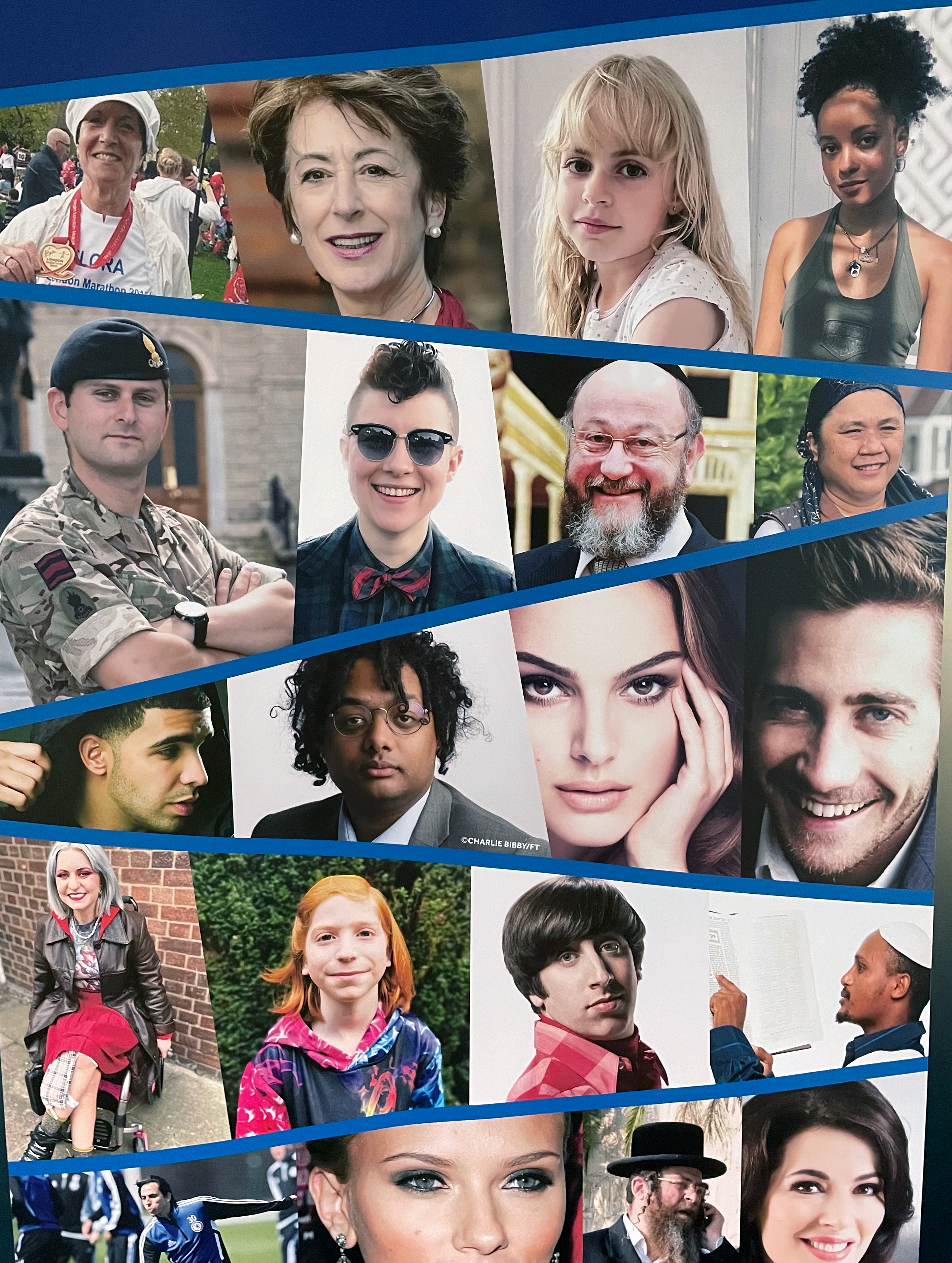
If you have heard anything about Jewish people, chances are you might know that Jews are often thought of as a religious group. But that's only part of the story. Jews are also a people. Jewish ethnicity, nationhood and religion are strongly interlinked. Although the Jewish people trace their origins to the Land of Israel in the Middle East, many have since lived all over the world, resulting in a rich diversity of cultures, languages, and religious practices.
How did Judaism start? Who was the ‘first Jew’ and why?
We need to go back about 4,000 years in history to a place called Ur (one of the world’s first cities in what is now Iraq) where a man named Abram (later changed to Abraham) grew up. At that time, worshipping multiple gods, mostly in the form of physical idols, was common practice. In contrast, Abram believed that there was only one God – an all-powerful creator of everything, who didn’t have a physical form. Abraham spread this idea and began to attract followers. We now call this belief monotheismA belief in one god..
Mono – one, the – god, ism – system or belief.
According to what is written in the TorahThe Jewish holy book (bible)., God appeared to Abraham and told him to leave his home and head for the land of CanaanThe name of the country now called Israel, in biblical times. (now called Israel). Abraham was later told by God that his descendants would be a large nation.
Abraham, Isaac and Jacob are known as the three patriarchs (fathers) of the Jewish people and their wives, Sarah, Rebekah, Rachael and Leah, are known as the four matriarchs (mothers).
Judaism, Christianity and Islam are known as the three ‘Abrahamic faiths‘ as they all stem from Abraham. Muslims come from the descendants of Ishmael.
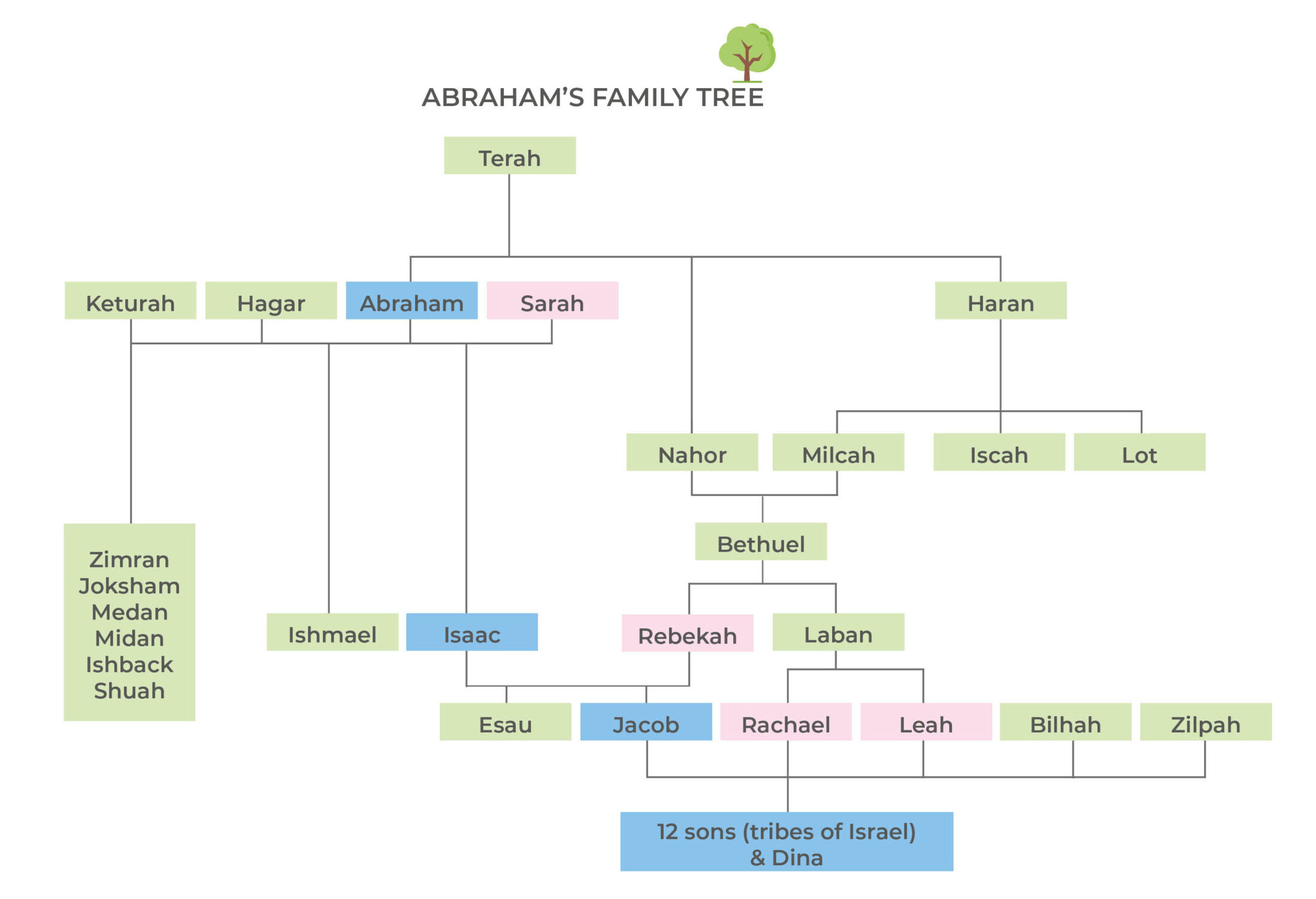
Jacob was also known as Israel, which is why this family (his 12 sons, one daughter and their families) became known as the ‘Children of Israel’ or the IsraelitesThe descendants of Jacob (who was known as Israel). The name ‘Jewish people’ is used for the Israelites after they received the Torah.. This is also why the country came to be known as ‘The Land of Israel’ (when the Jews conquered it from the Canaanites after the exodus from Egypt well over 3,000 years ago).
At various points in history, Jews were forcibly thrown out of the land of Israel by ruling empires, but there was always a majority who wanted to return.
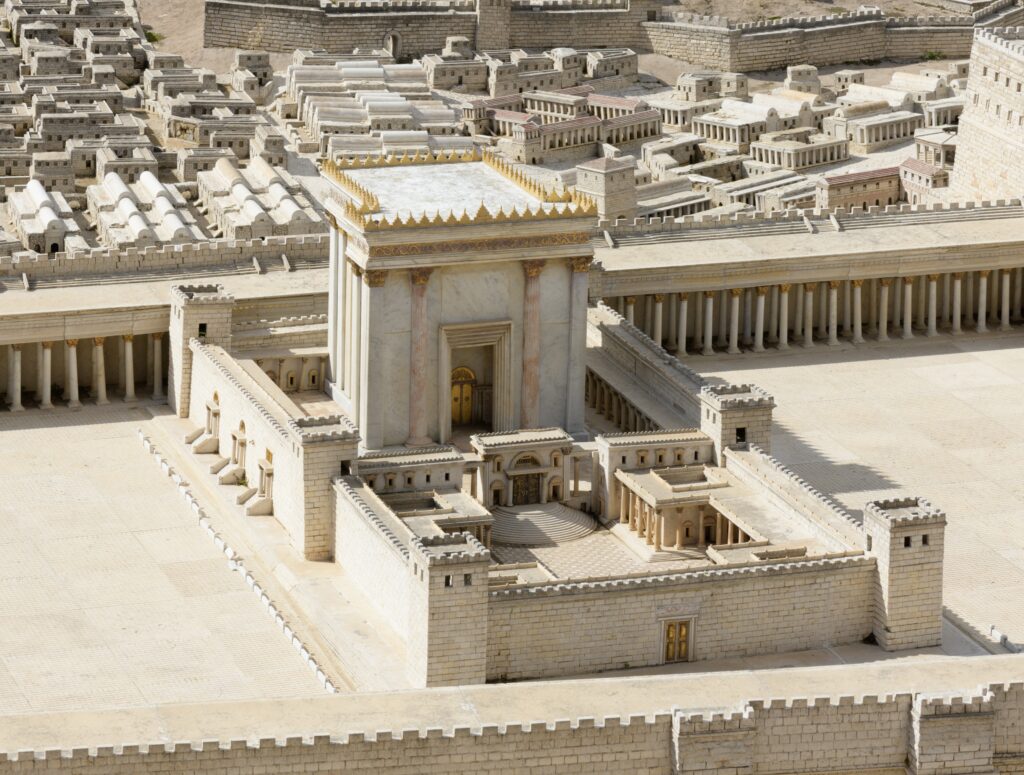
Early religious Jewish life in Israel centred around a large TempleA huge complex that stood in Jerusalem. It was the centre of Jewish religious life from about 1200 BCE – 70 CE. in Jerusalem. The TempleA huge complex that stood in Jerusalem. It was the centre of Jewish religious life from about 1200 BCE – 70 CE. was run by priests and many Jews would journey to it three times a year to bring gifts of agricultural produce and celebrate festivals. Religious Judaism of today is different as there is no TempleA huge complex that stood in Jerusalem. It was the centre of Jewish religious life from about 1200 BCE – 70 CE.. It is now led by rabbis (teachers) and centred around prayer services and celebrations in synagogues and the home.
The words ‘Jew’ and ‘Judaism’ comes from Judah, one of the sons of Jacob (therefore Abraham’s great-grandson). The large area in the centre of Israel was called Judea as the descendants of Judah (the Judeans) lived there.
Is Judaism a religion or an ethnicity?
Well, both! For some people it is one but not the other. Like most things, it’s complicated. That’s why we have this course…
Jews are an ethnic group, due to originating from one family and therefore having shared history and genes. However, people can become Jewish by converting though a religious process, so it’s not just an ethnicity. Likewise, some people who are born into a Jewish family may decide not to live a religious Jewish life, or even believe in God, but still feel strongly part of the Jewish people due to history and culture, so Judaism is not just a religion. Therefore, Judaism is called an ethno-religion and when we speak about Jews as a group, we refer to ourselves as a ‘people’.
Because Jews are both an ethnic and a religious group, under UK law, the rights of Jews are protected under anti-discrimination laws as well as the Race Relations Act. The Scottish census of 2022 listed Jewish as an option for ethnicity for the first time. 219 Jews identified as Jewish though ethnicity, but not religion.
AUDIO : “My Judaism is a big part of who I am. I live in a small community in Glasgow so a lot of my day-to-day life is outside of the Jewish community. I went to a Jewish primary school, however, there isn’t a Jewish high school here, so I’m at a school of 1,600 people who mostly aren’t Jewish.
My home life is very Jewish and very important to me. At home we keep kosher and never miss a Friday night dinner. We go to Shul every Shabbat. When I turned thirteen, I had my barmitzvah and I worked with the rabbi for a year to learn my Torah. I enjoyed showing my non-Jewish friends a bit of my Jewish life, finishing with a huge party.

This summer, I went on Israel tour to meet other Jewish people my age. I loved Israel and enjoyed meeting so many people that I have a connection with. ShabbatThe Jewish sabbath day (Friday evening to Saturday evening). Sometimes pronounced ‘Shabbos’ by Ashkenazi Jews. and festivals are really important to me because I can connect my family, friends and community, and enjoy going to ShulSynagogue (Yiddish). The highlights are probably the chat and the food. However, I have enjoyed the challenge of learning how to take part in the services.
My Jewishness reminds me that I am part of something meaningful and share history of my tribe all over the world. We’ve been going for thousands of years and I intend to carry that one.”
– Jonah, 16, Glasgow
World Jewish Population 2024
The Jewish community has a lot of diversity (variety and differences) within it.
Diversity of belief: Jews have differing ideas and beliefs about the origins of the Torah and how to live a good ‘Jewish’ life. Names of some of the ideological groups within Judaism you will find in the UK are HarediAn ideology within Judaism (see ‘Branches of Judaism page’ for more details)., OrthodoxOne of the major branches of Judaism., MasortiAn ideology within Judaism (see ‘Groups within Judaism’ page for more details)., ReformAn ideology within Judaism (see ‘Groups within Judaism page for more details). and LiberalAn ideology within Judaism (see ‘Groups within Judaism page for more details).. There are also many Jews who mainly identify as Secular, Humanist or Cultural Jews.
Geographical diversity: Jewish people have moved around the world a lot. Therefore we have all ended up looking very different, and have a variety of different local traditions as well as differing foods, music and language used. You may have heard the names Ashkenazi
Jewish group and culture primarily developed around Central or Eastern Europe., SephardiDescribes Jews of Spanish or Portuguese decent. and MizraḥiDescribes Jews from Central and West Asian countries, often Arabic-speaking countries. for groups of Jews who have lived in or travelled through and spent time living in different countries…
Words Matter
The words ‘antisemitism’ and ‘antisemitic’ sometimes confuse people because they sound similar to words we normally associate with positive things, like ‘anti-racist’. The word ‘Semitic’ has been used historically by linguists to describe a family of languages including HebrewThe language of the Jewish people and of Israel. Hebrew is also used more generally to mean the culture of the Jewish people (ie. Hebrew calendar). and Arabic. Some people wrongly think that antisemitismHostility to or prejudice against Jews as individuals or as a collective. must mean hating anyone who speaks those languages, but that is not accurate.
You’ll also often see people spelling these words with a hyphen and even a capital ‘S’ (‘anti-Semitic’). This would only make sense if there was actually something called ‘Semitism’! Since there is no such thing as just ‘Semitism’, we spell these words without a hyphen or capital S, to stop confusion.
Other terms you may come across are Judeophobia and anti-Jewish hatred, but antisemitismHostility to or prejudice against Jews as individuals or as a collective. is by far the most commonly used word in use today.
Antisemitism has only ever meant
Video Transcript: “The origin of the word antisemitism is attributed to German political activist and writer Wilhelm Marr in the middle of the 19th Century. Marr wanted an alternative to the commonly used Judenhass or “Jew hate”, which was based in religious persecution.
Being an atheist, he wanted to make his hate sound more “scientific”, so in 1879, he jumped on the European race pseudoscience that was fashionable at the time and… added more racism to the mix.
Marr even proudly formed a “League of Antisemites”, though it’s rumoured on his deathbed he was rather apologetic about the whole hateful mess.
Marr kept the word antisemitism deliberately vague-sounding, but it was only ever about hating Jews, and it has only been used for that since.